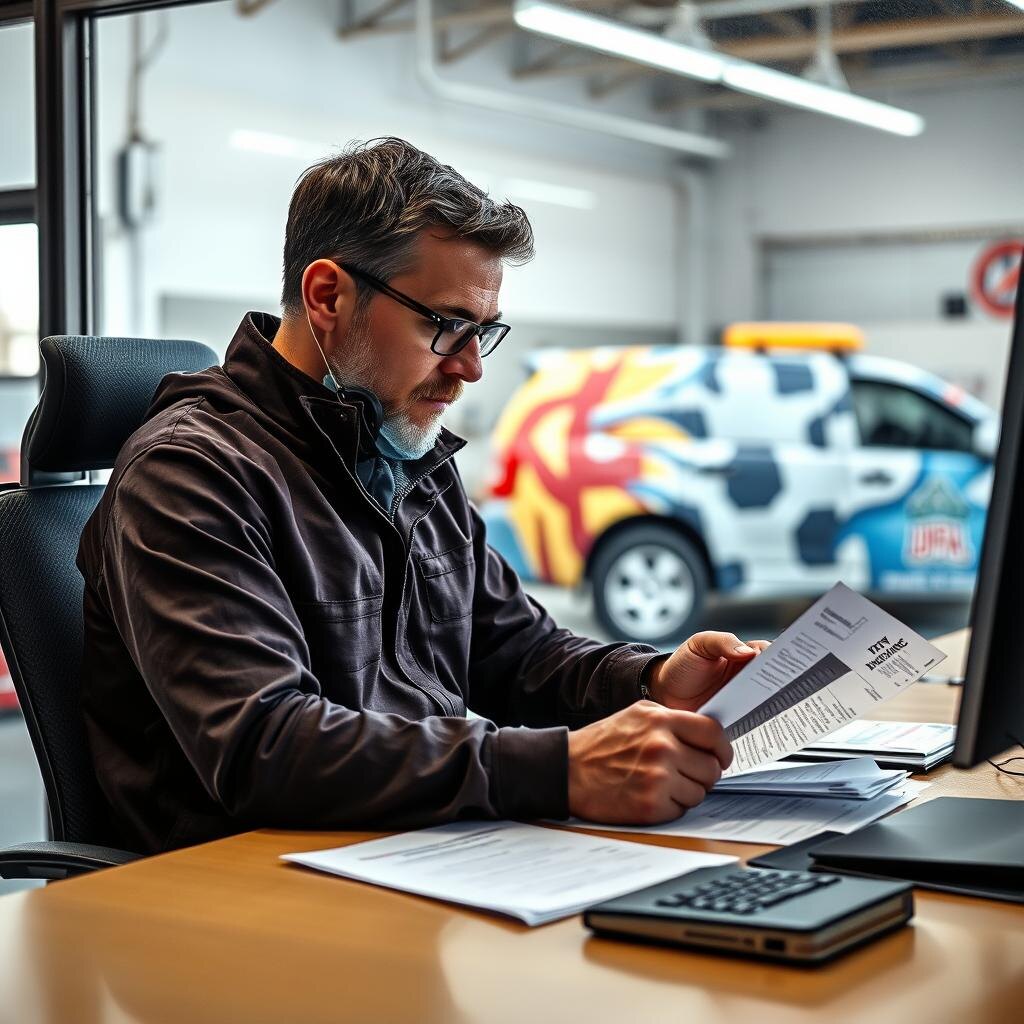
A vehicle wrap shop sits in an unusual risk position. You take temporary custody of a customer's high-value vehicle, then perform skilled hand work — applying, curing, trimming and sometimes removing adhesive vinyl and paint protection film — directly on every painted panel. That combination of holding the car and working on its paint creates exposures that standard small-business policies do not cleanly cover. This guide walks through every coverage a wrap or graphics shop actually needs, why each one exists, and what drives the price.
General Liability: The Foundation (And Its Big Holes)
General liability (GL) is the base policy every shop carries. It pays when a third party suffers bodily injury or property damage tied to your operations — a customer slips on backing paper in the bay, a stack of vinyl rolls topples onto a visitor, or your signage falls and dents a neighbor's car. It also covers personal and advertising injury and the legal defense costs that often dwarf the settlement itself. Standard limits are $1M per occurrence / $2M aggregate.
What GL does not do is just as important. It contains a care, custody & control exclusion, so it will not pay when the customer's vehicle in your care is damaged. It also carries "your work" and "your product" exclusions, so it will not pay to redo a defective wrap. Those two gaps are precisely why this trade layers other coverages on top.
Garagekeepers: The Coverage That Defines This Niche
Garagekeepers insurance fills the care, custody & control gap. Whenever a customer's vehicle is in your possession — being wrapped, waiting in the bay, or parked overnight mid-job — garagekeepers responds to physical damage and theft. That includes:
- Paint and clear-coat lifted during vinyl or PPF removal
- Heat-gun burns and overheated trim or plastic
- Squeegee scratches, knife marks and panel dents
- Theft, vandalism, fire, hail and weather damage while the car is on premises
It comes in two main forms. Legal liability pays only when you are proven negligent (cheapest, but it invites fault disputes). Direct primary / comprehensive pays for covered damage regardless of fault, which protects the customer relationship. Limits are set per location with optional per-vehicle sublimits — so size the per-location limit to the worst-case number of customer cars you could have in-bay during a single fire.
Tools & Equipment (Inland Marine)
A modern shop runs on expensive gear: roll-to-roll large-format printers, plotters and cutters, laminators, IR curing lamps, heat guns and install kits. Standard property forms often under-cover mobile or high-value equipment. Tools & equipment insurance, written as inland marine, covers this property against theft, fire and accidental damage — on-site, on the road to fleet jobs, and in transit. The loss of a single printer can halt production, so this is not optional padding.
Professional Liability (Installation E&O)
Because GL excludes "your work," it won't pay to redo a wrap that bubbles, lifts, peels, silvers or tunnels. Professional liability, also called installation errors & omissions, covers the financial loss a customer suffers from a defective install — the cost to reprint large-format graphics, the labor to strip and re-wrap, and the customer's downtime. It is especially critical for fleet jobs, where a single failure multiplies across every vehicle.
Commercial Property & Business Income
Commercial property covers your building or tenant improvements, plus contents — workbenches, racking, design workstations — and your inventory of vinyl, laminate, PPF and printed media. Add business income coverage so lost revenue and continuing expenses (rent, payroll) are replaced while you rebuild after a covered loss. Property is frequently bundled with GL in a Business Owner's Policy (BOP) for cost efficiency.
Workers Comp & Commercial Umbrella
Once you hire even one employee, workers compensation is legally required in most states. Installation carries real injury risk — blade cuts, heat-gun burns, repetitive-strain and back injuries, and solvent exposure. A commercial umbrella stacks extra liability limits on top of your GL, garagekeepers and auto, responding to catastrophic events like a shop fire that destroys several high-value vehicles at once. Umbrella coverage is cheap per million and is often required to win fleet, dealership and municipal contracts.
What Drives Your Premium — And Typical Costs
Premiums are driven by your payroll, the value and number of customer vehicles you hold, the value of scheduled equipment, your claims history, and the limits you choose. As rough benchmarks:
- General liability: roughly $60–$90/month ($750–$1,100/yr) at $1M/$2M
- BOP (GL + property): roughly $100–$140/month
- Tools & equipment: from about $150 to $4,500+/yr depending on gear scheduled
- Garagekeepers: priced on vehicle count, value and form; deductibles typically $250–$1,000
- Full program (GL + garagekeepers + inland marine + E&O + work comp + umbrella) for an established multi-employee shop commonly lands in the low-to-mid four figures up to ~$8,000–$12,000+/yr
The takeaway: a wrap shop is a garage-class risk wearing a contractor's hat. Build a normal GL/property/work-comp base, then layer garagekeepers and professional liability on top — and make sure your certificates of insurance can show additional-insured status when fleet clients ask.